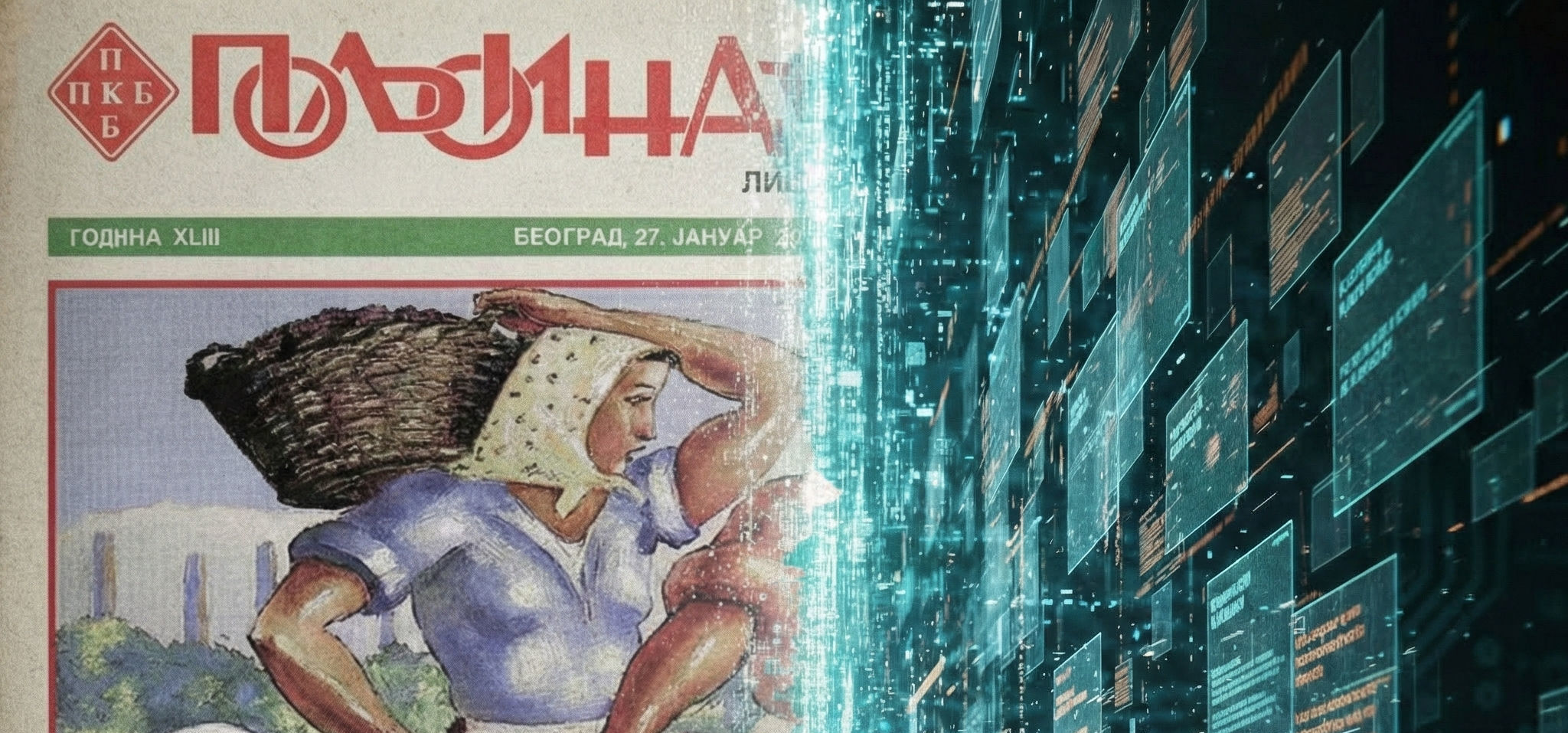
The Hidden Value of Old News: Why LLMs Need Cultural Heritage Data
Dark Data: Digitizing pre-internet physical archives to prevent LLMs from suffering “recency bias” (training only on the visible web).
Linguistic Drift: Teaching models that words like “Labor” or “Collective” carried fundamentally different semantic weights in 1970 vs 2024.
Truth is Temporal: Contextualizing facts based on their specific era to reduce historical hallucinations.
The “Dark Data” of the Pre-Digital Era
Large Language Models (LLMs) like GPT-4 or Claude are trained on the “visible” internet—Wikipedia, Common Crawl, Reddit, and digitized books. They possess incredible macro-knowledge of world history and dominant cultures. However, when you ask them about local history, niche cultural events, or life in a specific town fifty years ago, they often fail. They hallucinate generic answers because the data they need simply doesn’t exist in their training set.
The solution isn’t more web scraping. The solution lies in Digital Archaeology: unlocking the massive, high-density information trapped in physical newspaper archives.
For decades, local newspapers were the primary record of daily life. They captured everything from market prices and local elections to the opening of factories and the closing of schools. This information is “Dark Data”—it exists in physical libraries and basements, but it is invisible to modern AI.
By digitizing these archives, we aren’t just scanning images; we are recovering lost context. A single issue of a local paper from 1976 contains more granular data about that specific time and place than the entire public internet combined.
Linguistic Drift: How Language Evolves Over Time
One of the most valuable assets for LLM training is tracking Linguistic Drift—how the meaning of words changes as society evolves. Language is not static; it is a living record of political and economic shifts.
Newspaper archives provide a perfect, time-stamped dataset to teach models this nuance.
1. The Era of Collectivism (1970s)
In the mid-20th century, many regions operated under socialist or collectivist frameworks.
- Vocabulary: Terms like “Self-management,” “Worker Collectives,” and “Five-Year Plan” dominate the text.
- Context: Decisions are described as bottom-up processes. A “Director” has different responsibilities and social standing than a modern “CEO.”
2. The Transitional Era (1990s)
As political systems collapsed and economies shifted, language became fractured.
- Vocabulary: Old terms are suddenly replaced by loanwords like “Privatization,” “Inflation,” and “Joint-stock company.”
- Context: The tone of articles often shifts from optimistic reporting on production quotas to critical analyses of economic instability.
3. The Modern Era (2010s+)
Today, local papers often reflect globalized corporate standards.
- Vocabulary: “Corporation,” “Holding,” “Acquisition,” and “Human Resources.”
- Context: The language has standardized to fit the global market, losing some of the unique local flavor of previous decades.
Feeding an LLM this specific, dated progression helps it understand that truth is often temporal. A definition of “labor” in 1976 is fundamentally different from a definition in 2024.
The Engineering Challenge
Transforming fragile paper into training data is a non-trivial engineering task. It requires a robust pipeline:
- High-Fidelity Ingestion: Using tools like the ResCarta Toolkit to manage scanning and metadata, ensuring that every page is preserved with archival quality.
- Adaptive OCR: Standard Optical Character Recognition (OCR) often fails on old fonts or faded ink. We use optimized engines like Tesseract, fine-tuned for specific languages and historical typefaces (including Cyrillic).
- Structured Metadata (METS/MODS): It is not enough to just have text. The data must be wrapped in standards like METS and MODS. This tells the model when and where a text was written, allowing it to distinguish between a historical report and a modern opinion piece.
- Publication: As the final step, this data needs to be publicly available. Following strict standards for dataset creation, it must be verified, cleaned of OCR errors, and properly preprocessed to be usable for LLM training.
Example Collection
By controlling the digitization pipeline locally, we created the Poljoindustrija Digital Collection, specializing in newspapers covering the period from 1960 to 2018. We ensure that the unique history, language, and perspective of this specific culture are represented in the digital age.
Artifact Resources
- The Repository: Digital Heritage Collection