Safeguard-DH: Governing the 'Two Speeds' of AI
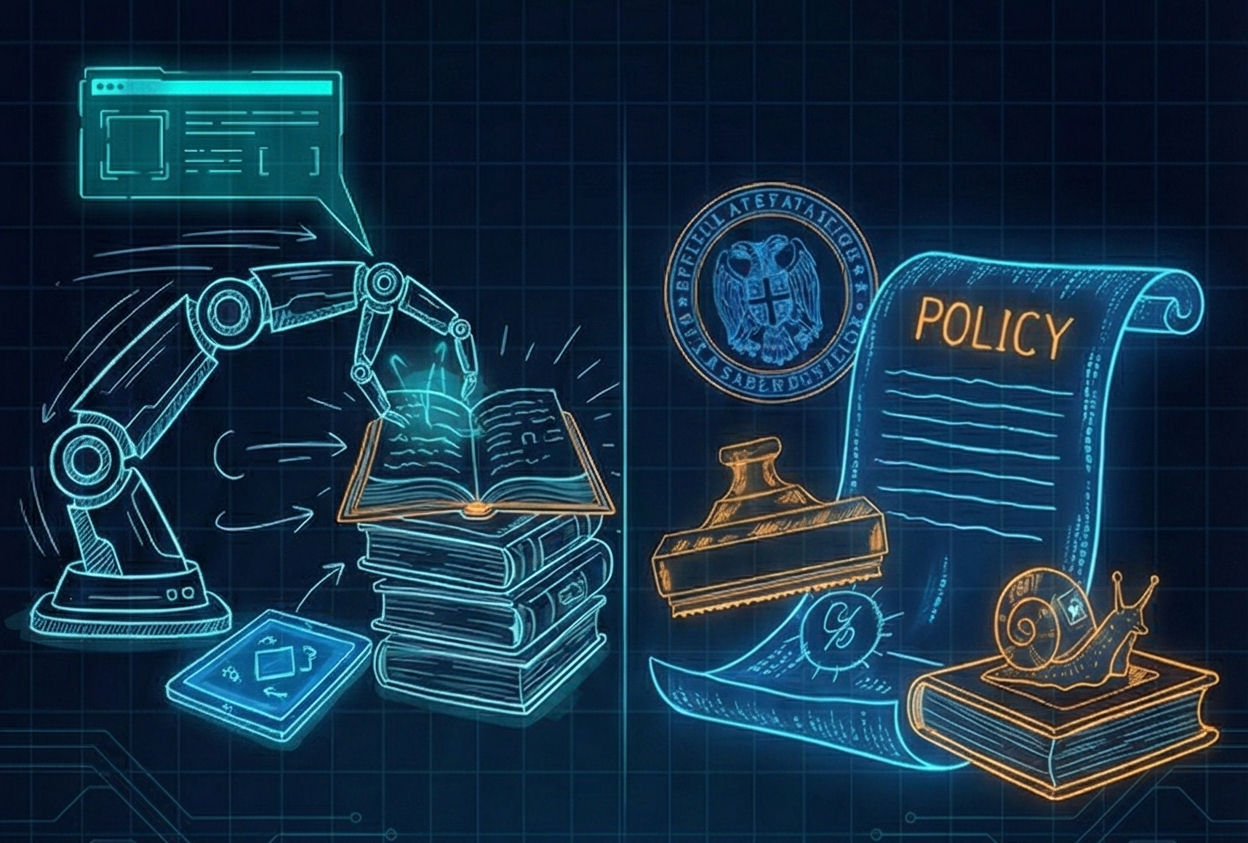
The “Two Speeds” Risk: Addressing the dangerous gap between rapid personal AI adoption and stagnant institutional policy.
Shadow IT: Mitigating the privacy risks of employees pasting sensitive institutional data into public, commercial LLMs.
ORRI Framework: A strategy focused on Open, Responsible, Reliable, and Interoperable AI use.
The Governance Gap: A Systemic Risk
As we integrate Large Language Models and autonomous agents into the GLAM sector (Galleries, Libraries, Archives, Museums), we face a critical Governance Gap. We have the technology to ingest millions of documents, but we lack the ethical operating system to manage how that data is used, hallucinated, or biased by AI.
Safeguard-DH (Responsible Digitalization and Ethical Governance for AI Futures) is not about building faster scanners. It is about building the decision-making infrastructure that prevents digital heritage from becoming a “black box”.
The “Two Speeds” Phenomenon
Our recent data analysis, conducted in December 2025, has uncovered a defining characteristic of the current AI transition in Serbia: the “Two Speeds of AI”.
As detailed in the video analysis above, the heritage sector is experiencing a dangerous friction:
- Speed 1: Rapid Personal Experimentation. Individual curators, librarians, and researchers are aggressively adopting tools like ChatGPT and Midjourney to solve immediate problems. They are moving fast, often bypassing protocol.
- Speed 2: Lagging Institutional Governance. Official institutions remain frozen. They lack the frameworks to regulate, support, or even understand these new workflows.
This disconnect creates “Shadow AI”—unregulated use of private models on public data. The Safeguard-DH project exists specifically to synchronize these two speeds.
The Core Protocol: ORRI Strategy
To bridge this gap, we are implementing an Open and Responsible Research and Innovation (ORRI) strategy. Think of ORRI not as a policy document, but as an institutional algorithm—a set of logic gates that guides every step of the digitalization workflow.
The framework targets three critical vectors:
- Responsible Digitalization: Moving beyond “scan everything” to “scan with intent,” ensuring data sovereignty and consent are embedded in the metadata.
- Anticipatory Governance: We cannot regulate AI by looking backward. We use AI Foresight and scenario-building roundtables to stress-test our institutions against future technological risks (e.g., deepfakes of historical figures, algorithmic bias in search).
- Public Trust: Re-establishing the library not just as a repository of books, but as a trusted mediator of digital truth.
The Pilot: A Living Lab in Belgrade
Theory requires a testbed. The “Milutin Bojić” Library serves as the primary pilot institution for the Safeguard-DH protocol.
Instead of theoretical discussions, the library is undergoing a full internal transformation:
- Workflow Integration: Embedding ethical checks directly into the digitization pipeline.
- Staff Training: Upgrading the capabilities of librarians to function as “AI Curators”.
- Community Engagement: Establishing structured feedback loops where the public—not just tech companies—has a say in how their cultural heritage is processed by AI.
The AI Act & Compliance
The European AI Act is reshaping the compliance landscape. Our partner ETIK.AI ensures that all Safeguard-DH protocols are not only ethically robust but legally compliant with the latest EU regulations on copyright, GDPR, and high-risk AI systems.
Artifact Resources
- Project Portal: Safeguard-DH Official Site
- Consortium: Partner Network
- Framework: ORRI Taxonomy